Wealth Management Technology: How the Modern Stack Fits Together (2026)
What wealth management technology is in 2026, the five layers every advisory firm runs, how they connect, what is changing with AI, and how to build a technology strategy.
Wealth management technology is everything an advisory firm uses to serve clients and run the business: custodians, CRM, portfolio and planning systems, the data that connects them, the workflows that move work along, the screens advisors and clients use, and now AI. The firms getting the most from it treat it as one connected system, not a list of vendors.
This guide explains the five layers of wealth management technology, how they connect, what is changing in 2026, and how to build a technology strategy that holds up as the firm grows. If you are comparing specific tools, start with our guide to wealth management software by category.
What is wealth management technology?
Wealth management technology (often called wealthtech) is the software, data and infrastructure behind advice. It covers how a firm records client relationships, holds and reports on investments, plans, trades, stays compliant, serves clients, and makes decisions about the business.
The term is broader than “software.” It includes the connections between systems, the firm’s data model, security and entitlements, and the operating habits that decide whether technology actually saves time.
The five layers of wealth management technology
Every advisory firm, from a single-office RIA to a national broker-dealer, runs some version of these five layers.
1. Systems of record
These are the systems where data is created: custodians such as Schwab, Fidelity and Pershing; the CRM; portfolio accounting; financial planning; compliance archives; and billing. Each is the source of truth for its own slice of the client relationship. Our wealth management software guide lists the leading tools in each category.
2. The data layer
The data layer pulls from every system of record and agrees on one definition of a household, an account, an advisor and a client. It reconciles differences, keeps history, and makes the data available to everything above it. In many firms this layer is spreadsheets and manual exports. In stronger firms it is a wealth management data platform the firm owns.
3. Workflows and automation
This layer moves work between people and systems: account opening, trade requests, money movement, service cases, onboarding and approvals. Good workflows start from data that is already known, so nobody retypes a client’s details. See our guide to workflow automation software for RIAs.
4. Advisor and client experience
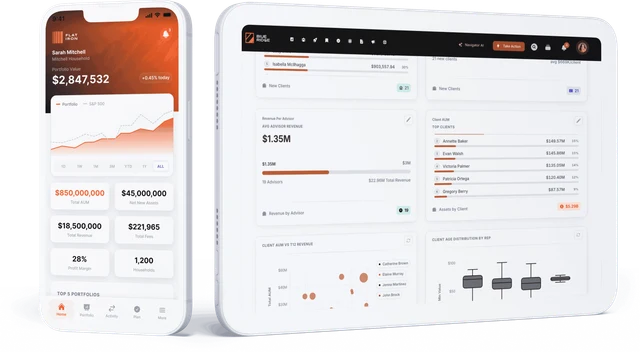
This is what people actually see: the advisor’s workstation, leadership dashboards, the client portal and mobile apps. The experience is only as good as the data under it. If the portal and the advisor screen read from different systems, they will disagree. Our guide to the single pane of glass explains why.
5. AI and analytics
AI assistants, natural-language questions, meeting prep, alerts and business intelligence sit on top. They need clean, connected, permissioned data more than any other layer, because an assistant that can see only one system gives partial answers. See AI-ready data for wealth management.
How the layers connect
| Layer | Job | Typical examples | What breaks without it |
|---|---|---|---|
| Systems of record | Create and store data | Custodians, CRM, portfolio accounting, planning | Nothing runs |
| Data layer | Connect, reconcile, keep history | Data platform, warehouse with pipelines | Numbers disagree across systems |
| Workflows | Move work and data between people and systems | Account opening, trade requests, service cases | Retyping, NIGO paperwork, lost requests |
| Experience | Show the right view to each person | Advisor workstation, client portal, dashboards | Advisors juggle many tabs and logins |
| AI and analytics | Answer questions, flag what matters | Assistants, alerts, BI | AI answers from one system, not the whole picture |
The order matters. Firms that start at the top, buying an AI tool or a new portal first, often find the results are limited by the data underneath. Firms that fix the data layer first find the layers above it get easier and cheaper.
Three ways firms connect their technology
Point-to-point integrations. Each system connects directly to the others. This works for a few systems, but the number of connections grows quickly, and each vendor change breaks something.
An all-in-one suite. One vendor covers most categories. Integration is simpler, but the firm accepts that vendor’s choices in every category and faces a large migration if it ever leaves. See vendor lock-in in wealth management.
A data hub. Every system connects once to a central, firm-owned data layer, which then feeds workflows, screens and AI. Firms keep the best tools in each category, and replacing one tool means changing one connection. This is the approach behind open architecture advisor platforms.
What is changing in wealth management technology in 2026?
- AI is moving from notes to actions. Assistants that started with meeting notes now prepare reviews, draft service requests and answer questions about a book of business. That raises the bar for data quality and permissions.
- Firms want to own their data. More firms keep a complete copy of their data in a warehouse they control, rather than relying on each vendor’s reports. See data ownership in wealth management.
- Standard AI connections are arriving. Protocols such as MCP let AI tools work with a firm’s data and systems through one governed interface. See MCP for wealth management.
- Multi-custodian is normal. Breakaway advisors, acquisitions and new custodians mean most growing firms hold assets in more than one place, which multiplies the data work.
- Consolidation keeps testing integrations. Every acquisition brings a second CRM, a second portfolio system and different household definitions that have to be reconciled.
How to build a wealth management technology strategy
- Write down the outcomes. Faster onboarding, fewer NIGOs, advisor time back, one view of the client, reliable firm-wide reporting. Technology choices follow from these.
- Inventory what you run. List every system, who owns it, what data it holds, and how data moves in and out today, including the spreadsheets.
- Define your core records. Agree on what a household, account, advisor and client mean at your firm, and which system is the source for each field.
- Fix the data layer first. Connect systems of record into one model before buying new screens or AI.
- Automate the highest-volume hand-offs. Start where people retype the most data or wait the longest, such as account opening and trade requests.
- Give each role one place to start. Advisors, operations and leadership should each have a screen that pulls from the shared data.
- Add AI with permissions. Make sure every AI tool sees only what the person using it is allowed to see.
- Review yearly. Retire tools nobody uses and check whether each vendor still lets you take your data with you.
Our RIA tech stack guide and how to choose a wealthtech platform go deeper on selection.
Common mistakes
- Buying screens before fixing data. A new portal or dashboard on inconsistent data shows inconsistent numbers more attractively.
- Letting each vendor define the client. Five systems with five household definitions means no firm-wide answer to “how many clients do we have.”
- Ignoring entitlements. As data is centralized, advisors must still see only their own book.
- Treating integration as a one-time project. Vendors change APIs, firms add custodians, and acquisitions bring new systems. Integration needs an owner.
We wrote more about this in the massive gap in most wealth management technology.
Where Milemarker fits
Milemarker is the data layer and everything built on it. The Data Engine connects custodians, portfolio systems, CRMs and planning tools into one firm-owned model. Command Center runs workflows such as account opening and trade requests from that data, Console gives advisors, leadership and clients their own views, and MCP lets AI tools work with the firm’s data under the same permissions. Firms keep the systems they already run.
Frequently asked questions
What is wealth management technology?
Wealth management technology is the software, data and infrastructure advisory firms use to serve clients and run the business, including custodians, CRM, portfolio and planning systems, data platforms, workflow tools, client portals and AI.
What is the difference between wealthtech and wealth management software?
Wealth management software usually means individual applications such as a CRM or planning tool. Wealthtech or wealth management technology is the broader picture: those applications plus the data, connections and infrastructure that make them work together.
How is AI used in wealth management technology?
AI is used for meeting notes and summaries, meeting preparation, answering questions about clients and the book of business, drafting service requests, and flagging opportunities or risks. It works best when it can see connected data from every system, with permissions applied.
What technology do RIAs need?
At minimum, a custodian, a CRM, portfolio accounting and reporting, financial planning, compliance archiving and e-signature. Growing RIAs add a data platform, workflow automation, an advisor workstation and BI. See Milemarker for RIAs and family offices.
How do I modernize my firm’s wealth management technology?
Start with the data. Connect your systems of record into one model your firm owns, agree on core definitions, then automate the busiest workflows and give each role a single place to work. New screens and AI deliver more once the data underneath is consistent.