




Case Study
The Rising Tide
Order isn't what tames intensity. It's what makes it work.

Jud Mackrill
Yesterday, I was on a call with some of my business partners when the sky went black.
Not gradually. All at once.
Thunder. Then lightning. The aggressive kind, popping around the house. My phone screaming from the lightning detection app. The windows behind me lit up. The windows in front of me lit up.
Ten minutes of violence that were more intense than the past couple of hurricanes to hit the South Carolina coast.
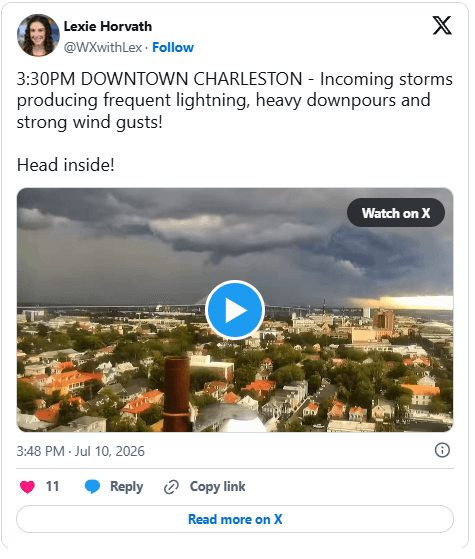
Then it was gone.
And the Charleston-in-July air that had been sitting on us for days was finally breathable.
My appreciation for this got sharpened this year. And not by me.
My oldest son is in undergrad. His freshman roommate is a meteorology major. Over the past year, the two of them and their friends turned into storm chasers. They drive toward the thing the rest of us drive away from.
So I've been getting an education secondhand. Radar screenshots in the group text. What a supercell actually is. Why does the sky go the color it does right before it breaks?
I used to just feel the weather. Now I half understand it.
And understanding it made me respect it more. Not less.
Because here's the thing about that storm.
It felt like chaos. It was the opposite.
A thunderstorm is one of the most ordered things the sky ever builds. Heat rises, moisture climbs, pressure loads, then it organizes into a column, discharges everything it gathered, and collapses in sequence. Same lifecycle, every time. Meteorologists don't measure a storm's power by how wild it looks. They measure how organized it is. The most violent storms are the most structured. A supercell is a rotating engine, tuned, holding its shape for hours.
The violence isn't the absence of order. It's what order looks like at speed.
We carry many definitions of intensity, and they play out differently depending on who's leading. Some run loud, felt in the room, always on. Some run quiet, where the intensity lives in the standard and not the volume. Some concentrate it into campaign mode, then recover. Some spread it thin and call always-on a virtue.
But the flavor doesn't predict who breaks. The loud leader and the quiet leader can both be healthy, and both can burn out.
Temperature isn't really the variable. Order is.
Intensity was never about how hard you're going. It's about how concentrated it is.
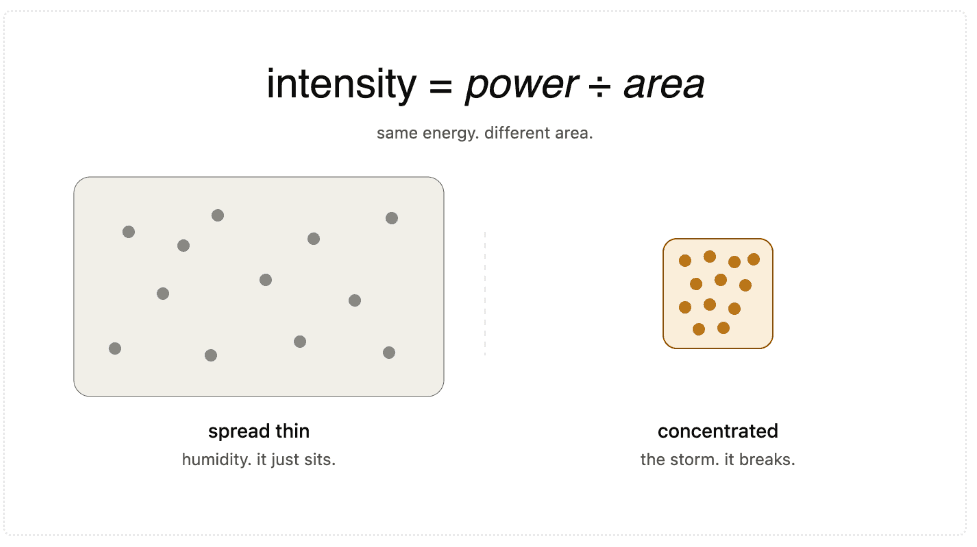
Physics is exact about this. Intensity is power divided by area. The same energy spread wider is weaker, every time. Not weaker in feeling. Weaker by definition.
Energy spread across everything isn't a little intensity everywhere. It's humidity. Same heat, same weight, nowhere to go, just sitting on you. A storm is that same energy, ordered: pulled into one window and released.
Spread it thin, and it sits. Concentrate it, and it breaks.
Here's the part most of us get backward. We think order tames the fire.
Backwards. Order is how the fire gets spent. The atmosphere loads up on heat and moisture, all of it lying around doing nothing, then organizes for one reason: to release it. The order and the release aren't the same thing. The order is the release. When it's spent, the storm is done, and the air is clean.
Intensity isn't the enemy of order. Intensity is what order does.
Most organizations think they're running storms. They're running humidity with a high thermostat.
It looks like this.
Everything is a priority, so nothing concentrates. Your top three is really your top eleven. The all-caps message goes out daily until all-caps means nothing.
The big initiative has no end. It's been a major focus for three quarters. No ship date. No cutover. No done. A storm has its collapse built in. This just hums.
The loudest client sets the week. Whoever calls first picks your intensity, and the refactor that would actually move the firm waits another quarter. Energy gets spent, plenty of it, on nothing that resolves.
And there's never a trough. You close Friday and start the next thing Monday. No clearing. Which means it was never a storm. Just weather that never ended.
All four feel like going hard. All four are humidity. Same heat, same weight, nowhere to go.
Most firms we work with already have the order. EOS. OKRs. Rocks for the quarter. Capital only sharpens it. The plan, the board cycle, the ninety-day number.
The order is there. The storm never comes.
The rock stays green for three meetings in a row. Not because it's moving. Because green means on track, and on track might just mean that no one was able to apply the level of intensity to it to get it to done.
A plan doesn't ship because you wrote it down. It ships when someone brings the weather.
This is why cadence beats effort. A cadence isn't what cools you down. It's the structure that lets you spend everything and recover.
You go hard on redoing your fee schedules. It ships. The air clears.
You go hard on the custodial conversion. It cuts over. The air clears.
You go hard on an M&A deal. You breathe. You to it again.
Same energy as the leader stuck at 30-70% on everything. Concentrated instead of spread. One breaks. One just sits.
In my experience, leaders don't burn out from big storms. They burn out from permanent humidity.
The thing we're all trying to reach isn't calmer. It's cleaner. A firm where intensity is directed and resolved, where storms come, do their work, and pass. Where the air actually gets to clear.
The storm isn't the enemy of the summer. It's what makes the building possible.
So find this week's storm and make the most of it.
This has been Jud Mackrill from the Channel 7 Storm Team. Have a great weekend!
Case Study
The Rising Tide
Order isn't what tames intensity. It's what makes it work.
Jud Mackrill
Yesterday, I was on a call with some of my business partners when the sky went black.
Not gradually. All at once.
Thunder. Then lightning. The aggressive kind, popping around the house. My phone screaming from the lightning detection app. The windows behind me lit up. The windows in front of me lit up.
Ten minutes of violence that were more intense than the past couple of hurricanes to hit the South Carolina coast.
Then it was gone.
And the Charleston-in-July air that had been sitting on us for days was finally breathable.
My appreciation for this got sharpened this year. And not by me.
My oldest son is in undergrad. His freshman roommate is a meteorology major. Over the past year, the two of them and their friends turned into storm chasers. They drive toward the thing the rest of us drive away from.
So I've been getting an education secondhand. Radar screenshots in the group text. What a supercell actually is. Why does the sky go the color it does right before it breaks?
I used to just feel the weather. Now I half understand it.
And understanding it made me respect it more. Not less.
Because here's the thing about that storm.
It felt like chaos. It was the opposite.
A thunderstorm is one of the most ordered things the sky ever builds. Heat rises, moisture climbs, pressure loads, then it organizes into a column, discharges everything it gathered, and collapses in sequence. Same lifecycle, every time. Meteorologists don't measure a storm's power by how wild it looks. They measure how organized it is. The most violent storms are the most structured. A supercell is a rotating engine, tuned, holding its shape for hours.
The violence isn't the absence of order. It's what order looks like at speed.
We carry many definitions of intensity, and they play out differently depending on who's leading. Some run loud, felt in the room, always on. Some run quiet, where the intensity lives in the standard and not the volume. Some concentrate it into campaign mode, then recover. Some spread it thin and call always-on a virtue.
But the flavor doesn't predict who breaks. The loud leader and the quiet leader can both be healthy, and both can burn out.
Temperature isn't really the variable. Order is.
Intensity was never about how hard you're going. It's about how concentrated it is.
Physics is exact about this. Intensity is power divided by area. The same energy spread wider is weaker, every time. Not weaker in feeling. Weaker by definition.
Energy spread across everything isn't a little intensity everywhere. It's humidity. Same heat, same weight, nowhere to go, just sitting on you. A storm is that same energy, ordered: pulled into one window and released.
Spread it thin, and it sits. Concentrate it, and it breaks.
Here's the part most of us get backward. We think order tames the fire.
Backwards. Order is how the fire gets spent. The atmosphere loads up on heat and moisture, all of it lying around doing nothing, then organizes for one reason: to release it. The order and the release aren't the same thing. The order is the release. When it's spent, the storm is done, and the air is clean.
Intensity isn't the enemy of order. Intensity is what order does.
Most organizations think they're running storms. They're running humidity with a high thermostat.
It looks like this.
Everything is a priority, so nothing concentrates. Your top three is really your top eleven. The all-caps message goes out daily until all-caps means nothing.
The big initiative has no end. It's been a major focus for three quarters. No ship date. No cutover. No done. A storm has its collapse built in. This just hums.
The loudest client sets the week. Whoever calls first picks your intensity, and the refactor that would actually move the firm waits another quarter. Energy gets spent, plenty of it, on nothing that resolves.
And there's never a trough. You close Friday and start the next thing Monday. No clearing. Which means it was never a storm. Just weather that never ended.
All four feel like going hard. All four are humidity. Same heat, same weight, nowhere to go.
Most firms we work with already have the order. EOS. OKRs. Rocks for the quarter. Capital only sharpens it. The plan, the board cycle, the ninety-day number.
The order is there. The storm never comes.
The rock stays green for three meetings in a row. Not because it's moving. Because green means on track, and on track might just mean that no one was able to apply the level of intensity to it to get it to done.
A plan doesn't ship because you wrote it down. It ships when someone brings the weather.
This is why cadence beats effort. A cadence isn't what cools you down. It's the structure that lets you spend everything and recover.
You go hard on redoing your fee schedules. It ships. The air clears.
You go hard on the custodial conversion. It cuts over. The air clears.
You go hard on an M&A deal. You breathe. You to it again.
Same energy as the leader stuck at 30-70% on everything. Concentrated instead of spread. One breaks. One just sits.
In my experience, leaders don't burn out from big storms. They burn out from permanent humidity.
The thing we're all trying to reach isn't calmer. It's cleaner. A firm where intensity is directed and resolved, where storms come, do their work, and pass. Where the air actually gets to clear.
The storm isn't the enemy of the summer. It's what makes the building possible.
So find this week's storm and make the most of it.
This has been Jud Mackrill from the Channel 7 Storm Team. Have a great weekend!


The Infrastructure for Wealth
Phone
+1 (470) 502-5600
Address
Milemarker Inc.
16192 Coastal Highway
Lewes, Delaware 19958
Built by Teams In:
Atlanta, Charleston, Cincinnati, Denver, Omaha & Portland.



Partners




Platform


Solutions
© 2026 Milemarker Inc. All rights reserved
DISCLAIMER: All product names, logos, and brands are property of their respective owners in the U.S. and other countries, and are used for identification purposes only. Use of these names, logos, and brands does not imply affiliation or endorsement.
The Infrastructure for Wealth
Phone
+1 (470) 502-5600
Address
Milemarker Inc.
16192 Coastal Highway
Lewes, Delaware 19958
Built by Teams In:
Atlanta, Charleston, Cincinnati, Denver, Omaha & Portland.
Partners
Platform
Solutions
© 2026 Milemarker Inc. All rights reserved
DISCLAIMER: All product names, logos, and brands are property of their respective owners in the U.S. and other countries, and are used for identification purposes only. Use of these names, logos, and brands does not imply affiliation or endorsement.
The Infrastructure for Wealth
Phone
+1 (470) 502-5600
Address
Milemarker Inc.
16192 Coastal Highway
Lewes, Delaware 19958
Built by Teams In:
Atlanta, Charleston, Cincinnati, Denver, Omaha & Portland.
Partners
Platform
Solutions
© 2026 Milemarker Inc. All rights reserved
DISCLAIMER: All product names, logos, and brands are property of their respective owners in the U.S. and other countries, and are used for identification purposes only. Use of these names, logos, and brands does not imply affiliation or endorsement.
Empowering Advisors
To Enjoy Every Mile.
Phone
+1 (470) 502-5600
Address
Milemarker Inc.
16192 Coastal Highway
Lewes, Delaware 19958
Built by Teams In:
Atlanta, Charleston, Cincinnati, Denver, Omaha & Portland.
Partners