




Case Study
The Rising Tide
Going Live

Jud Mackrill
I accidentally took a Waymo in Atlanta a few weeks ago.
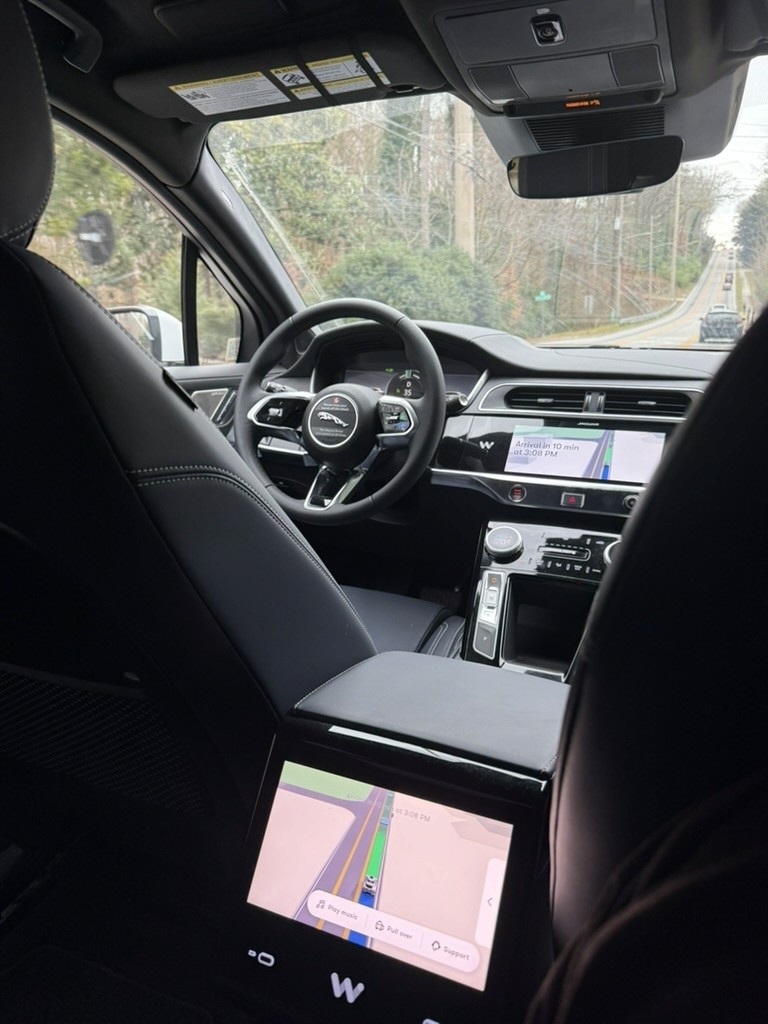
My Atlanta Waymo
Here's what happened: I ordered an Uber while on a highly detailed call and didn't really pay much attention to the Waymo notice, hopped in, and slowly crept to my destination. Just sensors, screens, and an empty front seat staring back at me like a confession of the future.
It was one of my top 10 worst Uber rides I've ever had.
The car was overly cautious at every intersection, hesitating at stop signs like a teenager with a learner's permit. It made routing decisions that made no sense—taking three right turns instead of one left. When another car wanted to merge, the Waymo just... stopped. Waited. Let itself get bullied by Atlanta traffic, which is not a city that rewards politeness.
But here's the thing I kept thinking about: this is temporary. The hesitation, the awkwardness, the inhuman rhythm of it—all of that will get optimized away. Eventually, Waymo will drive better than any human driver. Statistically, it probably already does.
Note that I wrote this article prior to seeing the news that people are still very actively involved in remotely controlling Waymo cars.
And that's the real problem.
When it works—really works—it'll be sterile. Safe. Optimized. The adventure gets automated out.
The Assembly Line Comes for Everything
We're watching automation accelerate in ways that felt theoretical six months ago.
If you've been paying attention to the AI agent space, you've probably heard of OpenClaw—the open-source AI agent that went from a weekend project to 100,000 GitHub stars in a week. People are buying Mac Minis specifically to run these things 24/7. They call it the "new team member." Not metaphorically. Literally: an autonomous system that checks your email, manages your files, and executes tasks while you sleep.
The assembly line was introduced in manufacturing a century ago. Now it's coming for everything else. Knowledge work. Creative work. The stuff we thought was safe because it required judgment.
And mostly, we're talking about this wrong. The conversation is always about what gets replaced. What I find more interesting is what becomes more valuable.
The Live Album Test
I've had live albums on repeat all week, and I think there's something useful in the comparison.
A studio can produce the perfect album. Every note precisely placed, every frequency balanced, every mistake erased. It's the Waymo of music—optimized, consistent, safe.
But there's something irreplaceable about real people playing real instruments in real time with real stakes.
Years ago, I spent time with Mike Mogis in his Lincoln, Nebraska studio, where we worked on an album for one of my friends at Presto!. Mike has built a career as a member of Bright Eyes and as a producer of several celebrated indie albums, including a couple by Phoebe Bridgers that won Grammys in recent years.
In the studio, the process of recording, editing, and refining is a grind. Hours adjusting tuning, adding layers, retaking riffs. Mike plays pretty much every instrument, has perfect pitch, and can understand what the artist is trying to achieve. He works in the moment to create something that will stand the test of time.
But it's art with an undo button.
Live recordings don't get that luxury.
Think about Nirvana's MTV Unplugged in New York. Kurt Cobain is clearly struggling. The performance is raw, vulnerable, and occasionally messy. He forgets lyrics. He changes arrangements on the fly. And it's devastating in a way that Nevermind can't touch—not because it's better produced, but because you're watching someone be human under pressure.
Or Rage Against the Machine's The Battle of Mexico City. There's no safety net. They're feeding off a crowd of 50,000 people, adjusting in real-time, channeling energy that can't be rehearsed. The studio version of "Killing in the Name" is precise. The live version is a confrontation.
Radiohead's In Rainbows: From the Basement is the inverse—controlled, deliberate, but with a tension that comes from knowing there's no second take. They're reinventing songs in real-time, trusting each other without a conductor.
The imperfections are proof of life.
What "Going Live" Actually Means
So what makes live performance work?
Improvisation—when the plan breaks down (and it always does), you adapt in the moment. Not with a pre-programmed backup plan, but with genuine creative response to something unexpected.
Collaboration—reading your bandmates, trusting without conducting, knowing when to lead and when to follow. This is different from coordination, which is just sequencing. Collaboration is anticipation.
Thinking on your feet—no undo button, no second take, no editing pass. The constraints create focus.
Reading the room—adjusting to the audience, the energy, the moment. The same song plays differently at a funeral than at a celebration. Context changes everything.
Presence—the stakes create a quality of attention that can't be faked. When failure is public and immediate, something sharpens.
These are the same skills that matter in work and life as automation handles the routine. The meeting where the slide deck doesn't matter as much as how you respond to the question that wasn't in your notes. The negotiation where the script breaks down. The presentation to the board where someone challenges your assumptions.
The live moments.
The Waymo Future
The Waymo will get better. The AI agents will get better. The studio will keep producing ever-more-perfect albums.
None of that makes the live skills less valuable. If anything, it makes them more valuable. When polished outputs become cheap, the ability to improvise becomes expensive. When consistency is automated, presence becomes rare.
I'm not arguing against automation. Progress is real.
But I'm increasingly convinced that the people who will thrive aren't the ones racing to automate their own capabilities. They're the ones doubling down on the live skills—improvisation, collaboration, thinking on their feet, reading rooms, and being present.
The future belongs to people who can go live.
Case Study
The Rising Tide
Going Live
Jud Mackrill
I accidentally took a Waymo in Atlanta a few weeks ago.
My Atlanta Waymo
Here's what happened: I ordered an Uber while on a highly detailed call and didn't really pay much attention to the Waymo notice, hopped in, and slowly crept to my destination. Just sensors, screens, and an empty front seat staring back at me like a confession of the future.
It was one of my top 10 worst Uber rides I've ever had.
The car was overly cautious at every intersection, hesitating at stop signs like a teenager with a learner's permit. It made routing decisions that made no sense—taking three right turns instead of one left. When another car wanted to merge, the Waymo just... stopped. Waited. Let itself get bullied by Atlanta traffic, which is not a city that rewards politeness.
But here's the thing I kept thinking about: this is temporary. The hesitation, the awkwardness, the inhuman rhythm of it—all of that will get optimized away. Eventually, Waymo will drive better than any human driver. Statistically, it probably already does.
Note that I wrote this article prior to seeing the news that people are still very actively involved in remotely controlling Waymo cars.
And that's the real problem.
When it works—really works—it'll be sterile. Safe. Optimized. The adventure gets automated out.
The Assembly Line Comes for Everything
We're watching automation accelerate in ways that felt theoretical six months ago.
If you've been paying attention to the AI agent space, you've probably heard of OpenClaw—the open-source AI agent that went from a weekend project to 100,000 GitHub stars in a week. People are buying Mac Minis specifically to run these things 24/7. They call it the "new team member." Not metaphorically. Literally: an autonomous system that checks your email, manages your files, and executes tasks while you sleep.
The assembly line was introduced in manufacturing a century ago. Now it's coming for everything else. Knowledge work. Creative work. The stuff we thought was safe because it required judgment.
And mostly, we're talking about this wrong. The conversation is always about what gets replaced. What I find more interesting is what becomes more valuable.
The Live Album Test
I've had live albums on repeat all week, and I think there's something useful in the comparison.
A studio can produce the perfect album. Every note precisely placed, every frequency balanced, every mistake erased. It's the Waymo of music—optimized, consistent, safe.
But there's something irreplaceable about real people playing real instruments in real time with real stakes.
Years ago, I spent time with Mike Mogis in his Lincoln, Nebraska studio, where we worked on an album for one of my friends at Presto!. Mike has built a career as a member of Bright Eyes and as a producer of several celebrated indie albums, including a couple by Phoebe Bridgers that won Grammys in recent years.
In the studio, the process of recording, editing, and refining is a grind. Hours adjusting tuning, adding layers, retaking riffs. Mike plays pretty much every instrument, has perfect pitch, and can understand what the artist is trying to achieve. He works in the moment to create something that will stand the test of time.
But it's art with an undo button.
Live recordings don't get that luxury.
Think about Nirvana's MTV Unplugged in New York. Kurt Cobain is clearly struggling. The performance is raw, vulnerable, and occasionally messy. He forgets lyrics. He changes arrangements on the fly. And it's devastating in a way that Nevermind can't touch—not because it's better produced, but because you're watching someone be human under pressure.
Or Rage Against the Machine's The Battle of Mexico City. There's no safety net. They're feeding off a crowd of 50,000 people, adjusting in real-time, channeling energy that can't be rehearsed. The studio version of "Killing in the Name" is precise. The live version is a confrontation.
Radiohead's In Rainbows: From the Basement is the inverse—controlled, deliberate, but with a tension that comes from knowing there's no second take. They're reinventing songs in real-time, trusting each other without a conductor.
The imperfections are proof of life.
What "Going Live" Actually Means
So what makes live performance work?
Improvisation—when the plan breaks down (and it always does), you adapt in the moment. Not with a pre-programmed backup plan, but with genuine creative response to something unexpected.
Collaboration—reading your bandmates, trusting without conducting, knowing when to lead and when to follow. This is different from coordination, which is just sequencing. Collaboration is anticipation.
Thinking on your feet—no undo button, no second take, no editing pass. The constraints create focus.
Reading the room—adjusting to the audience, the energy, the moment. The same song plays differently at a funeral than at a celebration. Context changes everything.
Presence—the stakes create a quality of attention that can't be faked. When failure is public and immediate, something sharpens.
These are the same skills that matter in work and life as automation handles the routine. The meeting where the slide deck doesn't matter as much as how you respond to the question that wasn't in your notes. The negotiation where the script breaks down. The presentation to the board where someone challenges your assumptions.
The live moments.
The Waymo Future
The Waymo will get better. The AI agents will get better. The studio will keep producing ever-more-perfect albums.
None of that makes the live skills less valuable. If anything, it makes them more valuable. When polished outputs become cheap, the ability to improvise becomes expensive. When consistency is automated, presence becomes rare.
I'm not arguing against automation. Progress is real.
But I'm increasingly convinced that the people who will thrive aren't the ones racing to automate their own capabilities. They're the ones doubling down on the live skills—improvisation, collaboration, thinking on their feet, reading rooms, and being present.
The future belongs to people who can go live.


The Infrastructure for Wealth
Phone
+1 (470) 502-5600
Address
Milemarker Inc.
16192 Coastal Highway
Lewes, Delaware 19958
Built by Teams In:
Atlanta, Charleston, Cincinnati, Denver, Omaha & Portland.



Partners



Platform


Solutions
© 2026 Milemarker Inc. All rights reserved
DISCLAIMER: All product names, logos, and brands are property of their respective owners in the U.S. and other countries, and are used for identification purposes only. Use of these names, logos, and brands does not imply affiliation or endorsement.
The Infrastructure for Wealth
Phone
+1 (470) 502-5600
Address
Milemarker Inc.
16192 Coastal Highway
Lewes, Delaware 19958
Built by Teams In:
Atlanta, Charleston, Cincinnati, Denver, Omaha & Portland.
Partners
Platform
Solutions
© 2026 Milemarker Inc. All rights reserved
DISCLAIMER: All product names, logos, and brands are property of their respective owners in the U.S. and other countries, and are used for identification purposes only. Use of these names, logos, and brands does not imply affiliation or endorsement.
The Infrastructure for Wealth
Phone
+1 (470) 502-5600
Address
Milemarker Inc.
16192 Coastal Highway
Lewes, Delaware 19958
Built by Teams In:
Atlanta, Charleston, Cincinnati, Denver, Omaha & Portland.
Partners
Platform
Solutions
© 2026 Milemarker Inc. All rights reserved
DISCLAIMER: All product names, logos, and brands are property of their respective owners in the U.S. and other countries, and are used for identification purposes only. Use of these names, logos, and brands does not imply affiliation or endorsement.
Empowering Advisors
To Enjoy Every Mile.
Phone
+1 (470) 502-5600
Address
Milemarker Inc.
16192 Coastal Highway
Lewes, Delaware 19958
Built by Teams In:
Atlanta, Charleston, Cincinnati, Denver, Omaha & Portland.
Partners